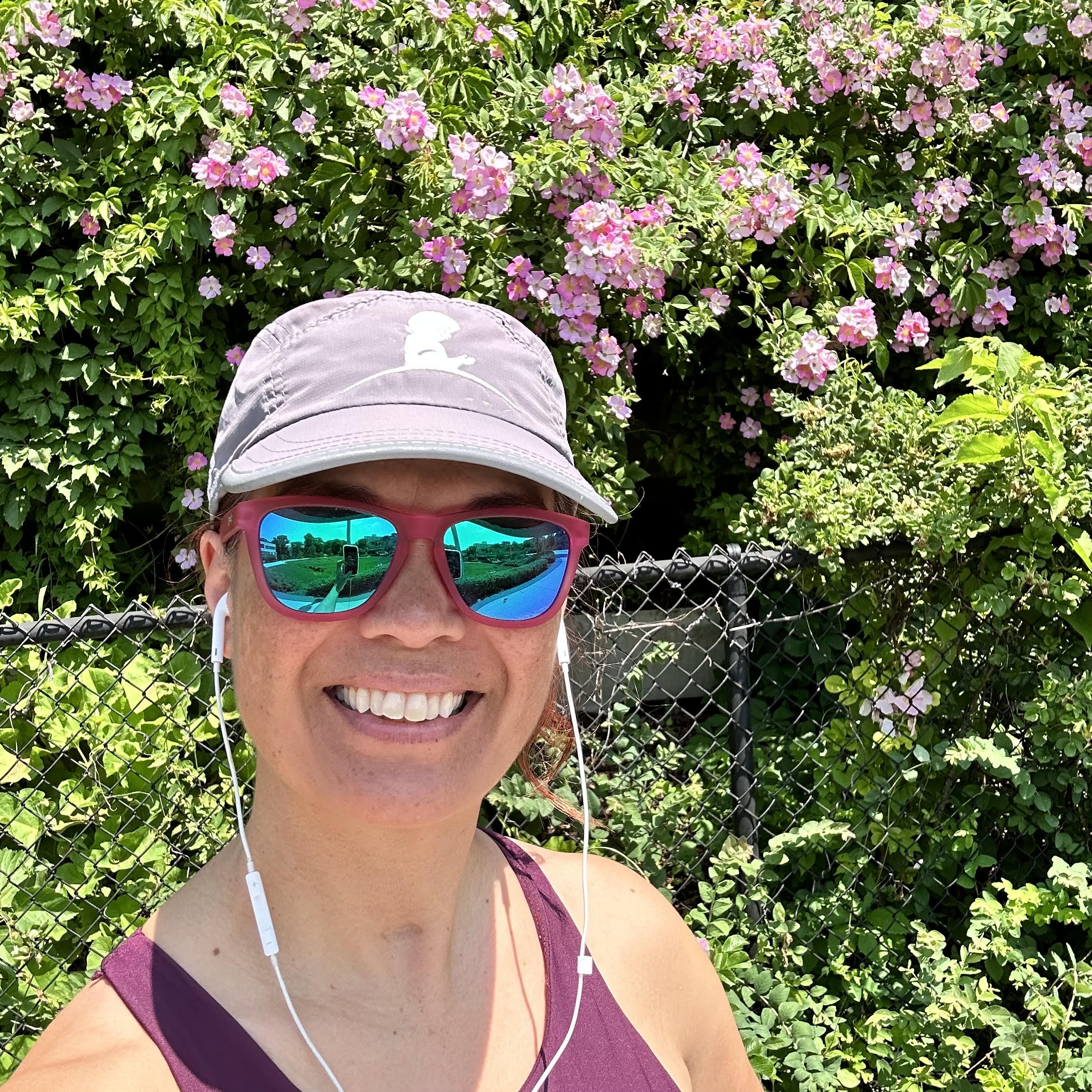
One Foot in Front of the Other

We are a little over five weeks away from the Chicago Marathon, and I have made it through most of my training. When I last wrote, I was preparing for my first ten mile run. Since then, I’ve completed the majority of my long runs: 10, 13, 14, and 16. I only have an 18 mile and 20 mile run left. Some runs have been better than others, but overall I am making progress, getting stronger, and (hopefully) faster. These changes aren’t just random; they are occurring because I keep running.

In order to be successful in marathon training, I have to keep getting out there and doing the training part. It’s not going to just happen. I have to make the choice to get up, put my running clothes on, head out the door….. and then RUN. If I completed all of the preparation steps but never actually ran, then I would never actually be ready for my race. The running is the hardest part, but it’s the part that is the most necessary. (This is also a very useful life analogy!)

I previously shared that I am working towards a goal of running a new personal best this year. To do so would mean that I would have to run the marathon in less than 4 hours and 57 minutes, my fastest marathon time from sixteen years ago. My last few long runs have been a struggle, and I haven’t been running at the pace needed to hit that goal. With that in mind, I have created a secondary goal of simply being able to finish as close as I can get to, or maybe even slightly under, five hours. While this might not seem like much of an adjustment, it’s just enough to keep me motivated during these last weeks of training and also keeps me close enough to my primary goal that I can keep pushing to maybe still accomplish it.

Throughout this training season, I have been encouraged by the support that has been shown to me. People who know that I am training for the marathon check in on my progress and ask me how things are going. Since I am running this race as a charity fundraiser for Girls in the Game, even more people have also supported those efforts by donating to my fundraising page – many of them complete strangers. Some of you reading this post even received it as part of my thank you email for your support. The kindness is not lost on me, and I have been taking all the positive energy in as marathon day gets closer. Knowing others believe in me makes it easier for me to keep putting one foot in front of the other. If you would like to donate to my efforts and continue with sending the love, you can use this link here. Even if you cannot donate anything, sharing this blog and the link with others and following my journey is a tangible way of showing your support. As a life coach and consultant, my motto is You Can Do It. I Can Help. As a charity runner trying to meet her marathon and fundraising goals, my personal motto is currently…

I Can Do It. You Can Help.

Thank you for all of your support!

Will I or Won’t I?

The last time I wrote, I shared that I was training for my 3rd Chicago marathon. Well, marathon training is ramping up with my first double digits run happening this weekend. I’ve been pushing myself to be consistent in my training in hopes of being able to – if not get a new personal best time – then to at least finish in under five hours. Seeing as the last time I ran a marathon in under five hours was over a decade ago, I know it’s a lofty goal. But, it’s one I’m still willing to work for.

I’ve shared here before that I love how running is truly an excellent analogy for life. We are all running this marathon called life together, and while there are always other factors at play, how well we do primarily depends on how much work we are willing to put in. We all have the same start and will all end up at the same finish. I’m not trying to be metaphorical here. We are all born, and we will all die. What we do with the time we have between those two points will determine how successful we are, just as the training I choose to do (or not do) determines how successful my marathon attempt will be.

As a former varsity cross country and track coach, I used to remind my athletes that they needed to focus on running “their” race. There were always going to be runners who were faster than them, and for some of them having a 1st, 2nd, or even 3rd place finish was not realistic. They needed to keep their own goals in mind as those were the ones that were realistic for them. Now, as a life coach for adults, I use a goal format where one of the tenants are for the goal to be “realistic.” It’s the non-running version of running your own race. While it’s important and necessary for us to aim high, if we consistently create unattainable goals for ourselves we will end up feeling defeated. I have always set high expectations for myself, my former students and athletes, and now my clients, but they have been designed around realistic outcomes. I never set a goal for a brand new runner who could barely run 10 minute miles to cut that time to 4 minute miles by the end of the season, but I would set the goal that they shave it down to 7 or 8 because while it would take hard work on their part, it was still something I knew they could accomplish.

So, I guess I said all that to say this – is running a marathon in under 5 hours a realistic goal for me? At this point and time, I’m saying yes. Now…ask me again a month from now, and we’ll see if my answer has changed. Follow along on my training journey to find out!

Also, I’m running the marathon in support of Girls in the Game, a fantastic organization providing sports programming and more for girls all throughout Chicago. If you’d like to make a donation, please click here for my fundraising page. Every dollar counts, and is fully tax-deductible.

Thank you for your support as both a reader and a donor!

Retirement’s Over

I’m sure no one has to tell you that running a marathon is hard. Even if you have never ran one yourself, have no desire to run one, or aren’t a runner at all, most people generally understand that training for and running in a marathon is a lot of work. If it were easy, everyone would do it right? So it shouldn’t come as too big of a surprise that when I ran the Chicago marathon for the second time back in 2021, I decided that it would be my last marathon until whenever I had the opportunity to run the original course in Greece. I actually told my partner that I was “retiring” from the marathon until that time. However, fast forward to 2024 and here we go again. I am officially running the Chicago marathon for a third time. I would say it’ll be my last, but life has taught me to never say never.

So what caused me to change my mind and return to a summer full of early mornings, long runs, speed workouts, and intense training? My love for Girls in the Game (GitG). GitG is a wonderful organization here in Chicago that provides sports programming for girls throughout the city. Just as we know that kids’ participation in sports is about more than the sport itself, GitG does so much more for girls than just provide sports instruction. The programs they run help girls to build a positive self-esteem and self-worth, develop their leadership and team building skills, and create healthy relationships that will endure.

Because I love GitG’s messages of girl power and overall female empowerment, I joined their Auxiliary Board last year as my way to support their work. So when they were asking for charity runners for this year’s marathon, there really was no way that I could say no (especially since they all knew “I was a runner”). I have ran as a charity partner for a couple of other organizations that I love, but this is the first time that I have ran for an organization where I have a first-hand opportunity to see the ins and outs of what my support means. I have also set a goal for myself to aim for a new personal record (PR) for my marathon time with this attempt, so I am more focused than ever on being true to training and preparation. This makes this fundraising/training cycle even more personal, and my hope is that these efforts pay off both in reaching (exceeding!) my fundraising minimum and achieving a time of 4 hours and 45 minutes in October. I love Girls in the Game, and I love being able to support them in this way. If you want to throw in your support of us both, please consider donating here: https://fundraisers.hakuapp.com/kimberly-frey and subscribe to this blog to get regular updates on my progress.

The Eyes Have It

When I was in elementary school, I participated in my school’s Young Author’s Conference. I believe I was in the third grade, although it was such a long time ago that I can’t be sure. I was extremely proud of my story, which placed in one of the categories and earned me a spot in the author’s conference session, where we were partnered with actual authors to share our stories, hear the feedback, and get advice from professionals. It was such an exciting accomplishment for me as I’ve shared before on this blog that I have always loved to write. This early experience convinced me that I could have a career as an author one day. As much as I loved to read when I was a child, it was exhilarating to believe that I could grow up to write my own stories for others to enjoy. Not only did I get to participate in the author session, but I was actually featured in our local newspaper. There was a large picture of me with my partner author, whose name I can’t currently recall, right in the middle of the page containing the full article. In the picture we are looking over my story together, and in the article itself, there are a few paragraphs dedicated to me and my story. I distinctly remember how excited I was about this whole event as a child, but decades later as an adult uncovering this article looking over it again brought up so many feelings of ostracism, isolation, and even shame.

How is it that one of my greatest achievements as a child could bring up so many negative feelings for me as an adult? To start, it’s important to understand that I am the first-born, first-generation daughter of a Filipino immigrant mother. I am so proud of my heritage – the way I was raised, the way my mother worked so hard to support me single-handedly the majority of my young life, and even the fact that she left behind everything she knew and everyone she loved to come to this country in order to make a better life for herself and her family. However, often being the only child of Asian descent in white, suburban middle America wasn’t without its struggles – especially as part of Generation X. Other children didn’t understand why I looked different and had no qualms expressing their opinions about it. According to many of my classmates, my skin was too dark, my nose was too big, and my eyes were too squinty or funny-looking. I was often asked what was wrong with me or why I “looked like that.” If I shared these incidents of teasing, ridiculing, or even sometimes outright bullying behavior with my mother, her response was to ignore it, work hard, prove myself by not getting in trouble and getting good grades, and eventually I would earn their respect. (There’s a reason why Asians were called the model minority for years.) Needless to say, that’s not what actually ever happened. While I intimately know and understand that we are responsible for our own choices and behavior in life, I also know that a lot of my younger self’s bad choices and behaviors were impacted by the way others treated me.

As a middle schooler, I went to live in Florida with my father where the racism and discrimination increased even more. To start with, I was the only Asian living in the all white family of my father, step-mother, and step-siblings. People didn’t understand how I was even related to them, and when they were told that my mother was from the Philippines, their initial reactions usually centered around assuming that my father had been in the military and my mom was a “rescued” bride. Disclaimer: my mother was already living in the United States working as a nurse when she met my father, who never served in the military. She didn’t need rescuing from anyone. Additionally, because I am only half Filipino coupled with the fact that in the mid-to-late 1980s the general public wasn’t as familiar with Filipino culture, no one ever knew what my ethnicity actually was. People assumed I was Hispanic, Black, Black/White mixed, Native American, or even Chinese. This ambiguity had me on the receiving end of basically every type of racial/ethnic slur at some point or another in my life as people would place me in whatever box they felt I fit. I could go on at length about those experiences, but suffice to say that they left an impact I can still feel today.

So going back to that newspaper article… When I came back home to Chicago, my mother gave me a keepsake album she had of mine. As I flipped through the pages, there was the aforementioned article jumping out at me. I instantly remembered the excitement and pride I had felt as a child living that experience and began reading the article. When I got to the part where the author was describing me, all I can remember is how the words “almond shaped eyes” jumped off the page and struck me in my soul. I had people make fun of my eyes all through my childhood and adolescence. As an adult, people have used my eye shape to justify their racism and discrimination. Looking at those words in the newspaper, all I could think was that this reporter was just one of countless many who helped shape the negative image I used to have about my eye shape that I still battle today. Even now, my go-to is to deflect my hurt that reading that statement caused for me and justifying it by saying that the reporter probably didn’t mean anything negative with her words and was just trying to describe me.

The eyes are the windows to our souls as they are usually the most honest part of our human bodies. As Asian American Pacific Islander month comes to a close, let’s remember to look past a person’s eye shape or any other preconceived ideas about them and instead towards our shared humanity and ways that we are interconnected so that we can create bridges and not walls.

Not a Grandma

You might have noticed the two beautiful kiddos with me on my About page. If you haven’t, you should go check them out because they are truly good-looking. Although I can’t take all the credit since they are not mine but my daughter’s.

Now before you rush to call me grandma, let me say that although I have two amazing grandchildren, I am not a grandma. I am known as Moma, which we’ve decided means “more momma” or “momx2,” whichever you prefer. See, I had my children when I was very young. I was actually still a teenager when my daughter was born. So even though she waited much longer to have her first child, when she did I was still relatively young in the grand scheme of things (pun intended). Trying to decide what my soon-to-be grandson would call me was a pretty complex process. I wanted to be called Lola, as that is the name for grandmother in Tagalog, a primary language in the Philippines, and I am a proud first-generation daughter of a Filipino immigrant mother. However, that’s what my children already called my mother, so having two Lolas in the family would be too confusing. Years prior to this, when my son first adopted his dog, he had declared that I couldn’t be his dog’s mom because he was his dog’s dad. Therefore, he had stated that I was the dog’s grandma. To which I quickly replied, “I am not a grandma.” He then went on to come up with “Noma,” short for “Not Grandma.” So when by grandson entered the world, I decided that Noma would work just fine. My grandson had other ideas. As much as I tried, I only managed to get him to say “Noma” one time. He would say, “no” and “ma” but when he would put it together, he would switch it to Moma. So, Moma stuck, and he loves the fact that he’s the one who gave me my name.

I’m sure you’ve heard the quote, “If I had known grandchildren would be so much fun, I would have had them first.” I had too, but you truly can’t appreciate it or understand its depth until you’ve had a grandchild. I love my children and would still do anything I can for them, but the love I have for my grandchildren is on a completely different level. They have enriched my life in ways that I didn’t even know was possible, and for that I am so grateful. I’m even more grateful for the fact that they only live a couple miles away from me so I get to see them on a regular basis. I have many friends who aren’t so lucky. While my children have always been my inspiration to work hard, set goals and achieve them, and live a life they could admire (or at least not be embarrassed of), my grandchildren are my inspiration to build something that will be around long after I’m gone, to create a legacy that they can one day inherit. So while I might be “More Momma” to them, my grandchildren are the grandest inspiration to me.

Every New Beginning…

Wow! It’s hard to believe that so much time has passed since the last time I posted here. To say there’s been a lot going on the last four years – both in the world and in my own life – would be quite the understatement.

Just as the world has changed dramatically since 2020, so has my life. I can’t wait to fill you in on it all, but the biggest (and most recent) change is that I left full-time teaching back in November. Professionally, it is definitely the most exciting, yet terrifying, thing that I have done – other than getting into teaching in the first place.

When I made the decision to go into teaching over 20 years ago, I was actually on a path toward being a social worker. Having had a tumultuous adolescence, I wanted to help kids who were also struggling to find their way. While going through undergrad, I worked at a residential therapeutic treatment center for adolescents in the evenings while also being a substitute teacher during the day. (At that time where I lived, you only needed a high school diploma for both positions.) Because I was experienced in supporting struggling students, I often subbed in what was thought to be difficult schools and/or classrooms. I developed relationships with the students, to the point where they would often say they wished I was their “real” teacher. Their words meant something to me, and I started to really consider them. As I did some research, I learned that I could get a special education teaching degree with a focus on teaching students with emotional and behavioral disabilities. I realized this was an even better way to help kids who were struggling because I could maybe make a difference in their lives sooner versus later. Once I made that decision, I spent my summer cramming in four additional classes that I needed so that I could be accepted into the special education program in the fall (after first having to request permission to do so from the program advisor). It was the best career decision I could have made.

I have loved every moment of being a teacher. Don’t get me wrong. There have been so many challenges throughout the years. But I have never regretted making that pivot in college and choosing education. Over the course of my career, I have taught every grade and every subject. I have loved my students and advocated for them as if they were my own. My own children grew up understanding that “my kids” were also a part of the family. To this day, I still remain in contact with many former students, and it warms my heart to see what they’ve accomplished with their adult lives.

It’s for all these reasons and more that making the choice to leave the classroom was one I didn’t make lightly. However, it’s because of the work that I’ve done over the last couple of decades that I understood now was the time to go. I have fought and advocated for my students for years. For them to realize the greatness that lies within, to turn their dreams into goals, and to help them meet their goals. I’ve fought for them to have access and be included versus stigmatized and excluded. I’ve worked to make schools places that are inclusive and welcoming for everyone – regardless of ability, disability, or identity. So much so that I knew I wanted to do the same for them as adults and the workplaces in which they were now a part (figuratively speaking). While schools have done a much better job of being inclusive and supportive over the years, the work world has not. At the same time, navigating adulthood isn’t a walk in the park either, and there is much to be said about the impact having a coach can play in a person’s success.

So, this is why I made the jump. This is why I HAD to make the jump. In a world that is often difficult to navigate and is becoming more divisive on so many levels, I want to be someone who helps adults identify and achieve their goals, creates more inclusive spaces for all, and still fights for students with disabilities by empowering families. As a life coach, disability inclusivity consultant, and special education advocate, I get to do all of these things and more. This new chapter of my life is just as exciting and fulfilling as being a teacher was, but in a whole new way.

Besides, when I start missing “my kids” too much, I just pick up some substitute teaching days and get right back in the classroom to get my fix. While my teaching career has come full circle, my coaching and consulting career has just begun.

2020 Isn’t Cancelled

Well, the first half of 2020 is behind us, and what a historic six months it has been! At the beginning of this year, people were so optimistic and excited. A new year, a new decade, a re-visiting of the 20’s – which personally is my favorite decade in history. The promise of the future was everywhere. And then, just as quickly as that promise was born, it began fading away. First, there were the reports of a new virus spreading half a world away. The next thing we knew, that virus was making its way across the globe and invading our country. Seemingly overnight, America went from being “open for business” to “closed indefinitely,” and our lives completely changed. Businesses and schools were closed, jobs were lost, and people were dying.

And then, there was more. In alarmingly rapid succession, we were confronted with Ahmaud Arbery, George Floyd, Breonna Taylor – every day people who all died in horrific ways. Their deaths released a barrage of emotions, and people were challenged to really analyze their feelings, be informed, speak up, and get involved. Every day there were reports of protests and even sometimes violent riots as people who were hurting, grieving, and angry lashed out at a society that has failed to hear their voices for far too long. However, these actions caused people of all races, ethnicities, and cultures to come together and loudly proclaim that “Black Lives Matter,” and a glimmer of hope was born that maybe, just maybe, this time they really would.

So, here we are entering the second half of 2020, and in many ways the world seems just as uncertain as it was a few months ago. However, the difference is we have already gone through these last few months, and have hopefully become stronger and smarter because of them. This new normal has taught us many things – many job functions can be performed at home, essential workers need to be protected because they are the ones who keep this country running, teachers should be valued more because wow! Their jobs actually ARE hard, history has a way of repeating itself (especially when the original history was written in a way that hid so much of the truth), masks save lives, and Black Lives Matter. What we choose to do with our new knowledge is up to us. Every individual has a choice: to learn and grow or stay stagnant and die. My dad used to say all the time that, “all living things grow and change. The only time you aren’t growing and changing is when you’re dead.”

As this roller coaster year starts its descend toward the finish, let us all take time to really evaluate who we are and who we want to be. Have you tried to push yourself out of your comfort zone? Have you read or watched something that challenged you? Have you been purposeful about finding opportunities to show compassion or thankfulness to others? Have you spent time listening respectfully to someone with a different viewpoint than yours? Even more importantly, have you spent time engaging in a respectful dialogue with someone whose views are not the same as yours? Are you someone who is searching for ways to be united or are you a person who is fostering division?

I, for one, would like to believe that when 2020 comes to a close we as a people will be able to look back and see that the events of this year impacted us in a way that ultimately made us stronger and better people. That this year caused us to come together in ways we never have before. That systemic changes occurred in this year which will benefit the most vulnerable in our society instead of continue to cause them harm. This year isn’t over yet, and it’s up to us to decide what lessons future historians will teach about the opening year of the 21st century Roaring Twenties.

New Year, New Reforms

Hello, and Happy New Year! The Roaring 20’s is one of my favorite time periods in history, and I look forward to what this new decade has in store for us. It’s been awhile since my last post, but now that the hustle and bustle of the holiday season is over, I’m ready to get back to work and am focused on my goals for the year.

Interestingly enough though, this post is NOT about my 2020 goal agenda. I was actually inspired to write this post because of events that unfolded during our mid-year standardized testing that occurred upon our return from winter break.

I have been teaching for almost 20 years, and I have spent the majority of this time teaching special education. Even during the years I taught high school, although I wasn’t specifically teaching special education classes, as a dual-licensed faculty member of the English department, if you were a student with an Individualized Education Plan (IEP) that qualified you for special education services, I was your English teacher. So as a teacher who has had to administer standardized tests to students with special needs every year, I am intimately aware of the fact that the overabundance of standardized testing, and the subsequent reliance on their results, has wreaked damage to a population of students who already have a plethora of obstacles hindering their educational success.

Just to be clear, standardized testing is not new. Ever since Alfred Binet developed an intelligence test in 1905, there has been standardized testing designed to determine if you are smart enough, performing to certain measures, and/or the right fit for the job (or school). However, when then-President George W. Bush’s No Child Left Behind Act was passed in 2001, the use of standardized testing proliferated, and is now present across all grade levels, even amongst our youngest students in preschool and kindergarten and our most fragile populations of students with special needs.

Going back to our school’s recent testing window, our district was conducting Middle-of-the-Year NWEA MAP testing. Within my district, this same test is given at the end of the year as well. If you are in certain “benchmark” grades and you don’t pass the test, it is mandatory for you to be retained.

The MAP test in and of itself is not the worst test out there. It is an adaptive test. It is designed to either increase or decrease the rigor depending on the student’s performance. However, it also purposefully gives students questions on topics they haven’t been taught yet (supposedly to determine the student’s readiness for those topics). It is an untimed test, and students are allowed to take a break, pause the test, or even suspend it until a later time. All of this sounds great in theory. Until you have a student in the third grade on the Autism Spectrum who has extreme testing anxiety or a fifth grade student who has been diagnosed with significant emotional disabilities and is currently living with his aunt as his foster parent due to the emotional trauma he suffered when living with his mother. Both of these students are below-grade level. Their teachers already know that. Their cognitive and academic testing that was completed in order for them to qualify for special education services has proven that. The progress monitoring that is completed all throughout the year to determine whether or not they are on-track to meet their IEP goals shows their progress and keeps all of their teachers accountable. But yet, these students, and thousands like them, are required to take a test that creates undue stress and negatively impacts their self-esteem. My third grade student with autism was so frozen with fear all he could do was sit and cry. My fifth grade student had a complete breakdown in the testing room and had to be removed altogether. Why are non-educators so intent on forcing kids who already know what they don’t know (and feel inferior to their peers because of it) to prove on a test what exactly they don’t know?

For the parents who are reading this blog, please know that this unhealthy pattern of over-testing and developmentally inappropriate testing will continue until you band together and demand change. Teachers will support you if you demand testing policy overhauls, because teachers know that all this testing isn’t in the best interest of any of our students, not just those with special needs. The testing craziness began in earnest with politicians who didn’t have any teaching experience of their own trying to hold teachers accountable. (Oh, the irony, I know.) It is time to tell our current, and future, politicians that the harm we are causing our children must be put to an end. Let’s put policies in place that ensure that no student has to walk out of a room feeling broken and defeated. Now that would truly ensure that no child is left behind.

Waiting for a Truly Good Deal

This week, approximately 94% of Chicago Public School educators, clinicians, paraprofessionals, and school-related personnel voted in favor of authorizing the Chicago Teachers Union to authorize a strike if a satisfactory contract cannot be reached with the Chicago school district, and ultimately the newly elected Chicago mayor Lori Lightfoot.

Mayor Lightfoot campaigned under the banner of eliminating old-school politics. On her own campaign website, lightfootforchicago.com, the then-candidate stated that, “We must do better to halt the declining conditions of our neighborhood schools. We must do better to change an education policy that does not view parents, teachers, principals, staff or other stakeholders as valued partners. We must do better by insisting on a comprehensive plan to invest in families and neighborhoods, and to end the violence that plagues too many communities.” The contract that the CTU is currently fighting for is wanting to do just that. With their overwhelming vote this week, teachers are saying that it is time to eliminate the inequity that exists in Chicago schools, and it is time to prioritize agendas that research has proven will help children be more successful in school.

Let’s start with class sizes. Although there is a plethora of research proving that smaller class sizes are a fundamental piece of the academic success puzzle, schools all across the city are grossly over-crowded. I personally know of elementary school classrooms where anywhere from 32- 35 children are sitting in one room with one teacher and up to 37-38 middle school students are doing the same. If Mayor Lightfoot is serious about wanting students to achieve, then there should not be any hesitation on her part to include language in the contract that assures the district will begin taking steps to address overcrowded classrooms.

The next item on the agenda? School nurses. I personally do not know of a school on the south side that has a full-time nurse at their school every day with the exception of schools that have a large population of students with special needs who require medical assistance during the day. I currently have students with a myriad of medical conditions such as allergies, asthma, and seizure disorders. If one of these students has a medical emergency, we basically know to call 911 and hope for the best. Medical conditions aside, if a student falls and hits his/her head on the playground, we do not have a nurse to determine if a severe head injury has occurred. However, talking to parents of students on the north side, many of those schools have the discretionary funds due to parent and community donations to pay for a nurse themselves. Instead of stating that there is a nurse shortage all over the state, why won’t the mayor show her commitment to finding solutions to the problem by including language in the contract that addresses the situation?

Let’s also talk about those social workers the union is calling for. Currently, most schools on the south side do not have a full-time social worker. In fact, most of these schools have a social worker who only comes one day a week, with maybe a second day every other week. These are the very schools that are serving students who experience trauma, violence, and the effects of gang violence along with that of drug and alcohol abuse. It is very difficult for students to focus on their education when they are worried about whether or not they will be shot on their way home from school. To truly be committed to ending violence in this city means that we must truly be committed to helping support the students’ social/emotional and mental health in the very communities where the violence has caused the most damage.

Lastly, let’s bring to light a little-known fact about the current “good deal” that is being offered to Chicago teachers. The current proposal is calling for a reduction of planning time for teachers, who already often lack the proper planning time necessary to adequately teach students. However, this proposal is being buried by both the mayor’s office and the news media who are endorsing her deal.

The very fact that Mayor Lightfoot, the Chicago Tribune, and the Chicago Sun-Times are all urging teachers to just take the deal because the financial terms are “generous” (Chicago Tribune editorial, 9/13/19) shows the lack of understanding as to what this fight is all about. It’s not about money (although more money would be nice). Chicago teachers, so by default the Chicago Teachers Union, are not strike-hungry as those in the media are stating. In fact, the overwhelming majority of teachers do not want a strike. We want to be in our schools with our students. To be honest, having just come back from the summer break (which to make very clear to the public – we DO NOT get paid for; nor do we even collect a check….for about two months), teachers really can’t even afford to strike. However, we cannot support a deal that continues to put our most disadvantaged students at an even greater disadvantage and has no real plan for how to remedy the situation. That is how important this struggle is to us as champions of our youth. We are willing to risk financial strain and the possibility of negative opinions from the public as we fight for what our students so rightly deserve.

If you are serious about halting the declining conditions of neighborhood schools and changing educational policies, then address these issues, Mayor Lightfoot. Be willing to be the mayor that the overwhelming majority of Chicago citizens believed you were going to be when you won the election. Then, and only then, will we truly have a “very good deal.”

For further opinions on this topic, please read my colleague’s editorial which can be found at https://chicago.suntimes.com/2019/9/26/20885381/chicago-teachers-union-strike-vote-class-sizes-social-workers-librarians-letters-to-the-editor